
October 2026
Executive Summary:
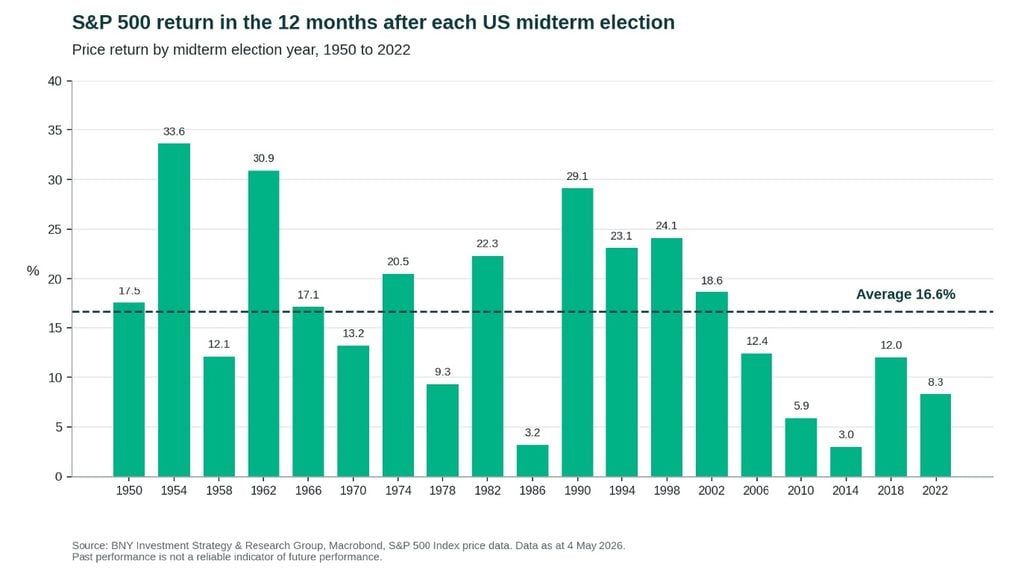
Midterm elections reliably create market jitters. The months before voters head to the polls usually trigger volatility, but once the ballots are counted and the legislative picture clears, markets tend to rally. Historically, the S&P 500 surges for an average 16% return in the year following a midterm vote. For financial advisers, a divided government is often the most profitable outcome, as congressional gridlock typically generates the highest equity returns. Ultimately, short-term political drama takes a backseat to the real engines of long-term portfolio growth. Federal Reserve policies, inflation trends, and corporate earnings dictate market performance far more than who controls Capitol Hill.
If your news feed has been full of American politics lately, you’re not imagining it. On November 3rd (the morning of November 4th for us), US voters head to the polls for the midterm elections. These happen halfway through a president’s four-year term, with every seat in the House of Representatives and about a third of the Senate up for grabs. Clients are asking whether it matters for their portfolios. Our view: a little, but probably less than many might assume.
What history tells us
Midterm years have tended to be among the weakest for US shares, and much of that softness arrives in the months before the vote, when nobody knows the result. Once the outcome is clear and the uncertainty fades, shares have often recovered. Going back to 1950, the S&P 500 (an index of 500 large US companies) has gained around 16% on average in the 12 months after a midterm election. This year has already broken the pattern, as US shares have climbed to record highs after a dip in March.
What the betting markets expect
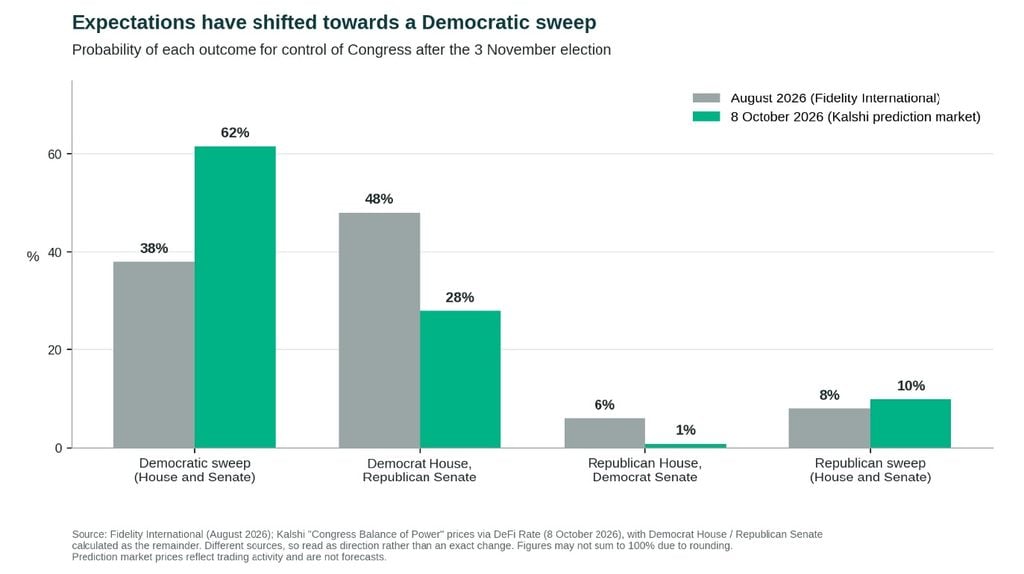
Prediction markets, where people put real money on political outcomes and are increasingly popular in the US, currently give the Democrats about a 90% chance of winning the House and roughly a 60% to 65% chance of winning the House and Senate. Control of both chambers is called a “sweep”. A split Congress is priced at around 30%, and a Republican sweep at around 10%.
Why the mix matters
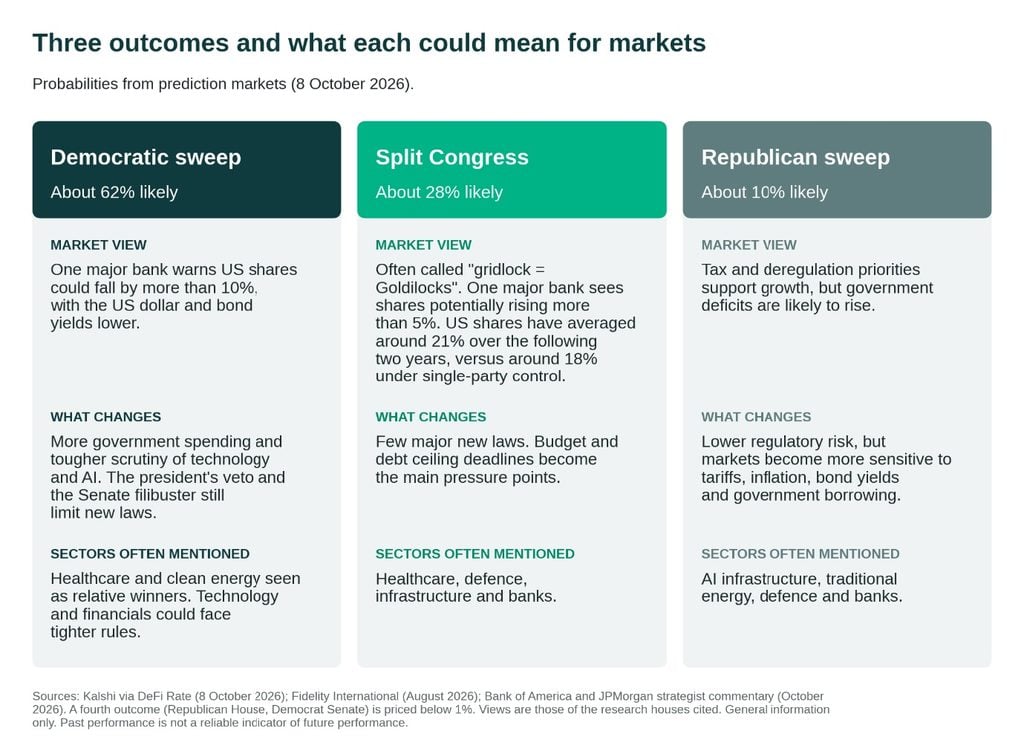
A split Congress is often called “gridlock”, because it’s harder to pass big new laws. Markets tend to like that, as it means fewer surprises. One major bank found that US shares have averaged around 21% over the two years following a gridlock result, compared with around 18% under single-party control, going back to 1950.
A Democratic sweep is where views differ. One prominent strategist warns US shares could fall more than 10%, mainly on the risk of tougher scrutiny of the big technology and AI companies that have driven much of the recent market gains. Others are less concerned. The president keeps control over areas like tariffs, and tax cuts already passed would be hard to reverse. Any impact is also likely to show up by sector rather than across the whole market. Healthcare and clean energy are often mentioned as relative winners under Democratic control, while banks and energy companies tend to be favoured if Republicans hold on.
The bigger drivers
Most strategists still see other forces as more important over the next few months. US inflation has picked up again, partly because of higher energy prices, and the US central bank (the Federal Reserve) has been raising interest rates. Higher rates make borrowing more expensive and can weigh on share prices, particularly for fast-growing companies. Options traders, who bet on how far markets will move, are expecting a move of less than 1% in the days after the vote.
The bottom line
Elections create plenty of noise, but over time share markets have been driven far more by earnings, interest rates and the health of the economy than by which party is in power. Moving in and out of the market around a vote is hard to get right, and missing the recovery that often follows can be costly. A diversified portfolio is built to cope with different outcomes, so no single election result should force a change. We’ll keep watching, but our view is that the midterms are a reason to stay the course, not to change it.

Written by Christopher Lioutas
Chair of Investment Committee – Harbourside Investment Management
This information is general advice and does not take account of investors’ objectives, financial situation or needs. Before acting on this general advice, investors should therefore consider the appropriateness of the advice having regard to their objectives, financial situation or needs.