May 2026
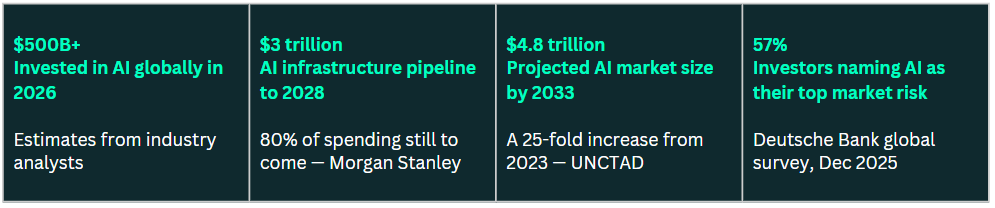
Turn on the news at the moment and it won’t be long before someone mentions artificial intelligence (AI). But it’s not just the technology itself driving headlines. It’s the extraordinary amounts of money being committed to build it. The world’s biggest technology companies are planning to spend hundreds of billions of dollars on AI infrastructure, and the scale of that investment is starting to raise real questions for investors: What exactly is all this money being spent on? Why are they spending so much? And what does it mean?
A Quick Guide to the Jargon
A few terms come up repeatedly in this conversation, and they’re worth understanding:
- Hyperscalers are the world’s largest technology companies that run massive cloud computing networks (think Microsoft Azure, Google Cloud, Amazon AWS and Meta). They’re called hyperscalers because the computing power they operate runs at an almost unimaginable scale.
- GPUs (Graphics Processing Units) were originally designed to render video game graphics. It turns out they’re also exceptionally good at the complex mathematics needed to train and run AI models. Nvidia makes the most powerful ones, which is why the company has become one of the most valuable in the world.
- Data centres are the physical buildings, often enormous warehouse-sized facilities, that house the computers, chips and cooling systems required to run AI. Building and powering these is where the bulk of the spending goes.
What Are the Big Players Actually Planning to Spend?
The numbers are genuinely staggering. Microsoft, Google, Amazon and Meta are collectively expected to spend close to $800 billion on AI infrastructure in 2026 alone, with commitments stretching years into the future. To put that in perspective, the chart below compares planned AI data centre investment to some of the largest infrastructure and engineering projects in human history.
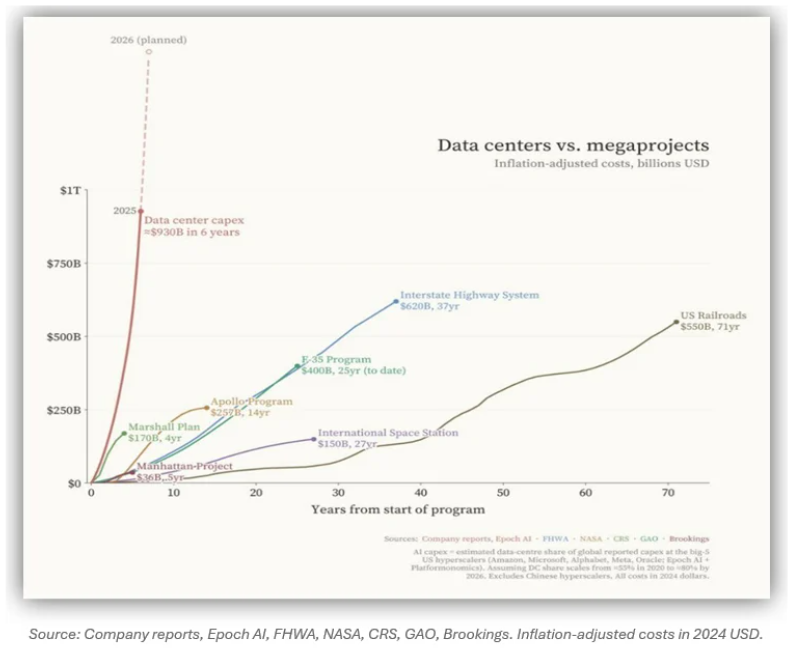
In roughly six years, AI data centre investment is on track to surpass the entire cost of building the US Interstate Highway System, a project that took nearly four decades. It dwarfs the Apollo program, the Marshall Plan and the International Space Station combined.
Each of the major players has their own angle. Microsoft is deeply tied to OpenAI (the company behind ChatGPT) and is embedding AI across its entire product range. Google is integrating AI into search, advertising and its cloud platform. Amazon is expanding its cloud business and developing its own AI chips. Meta is investing heavily to improve its social media platforms. And Nvidia sits at the centre of all of it, supplying the chips that make the whole thing possible.
Why Are They Spending So Much?
Each company believes it cannot afford not to. Falling behind on AI could mean losing ground to competitors in their core businesses, and the consequences of that would be enormous. If your cloud platform is less capable than a rival’s, or your search engine less useful, customers will go elsewhere.
There is also a genuine belief, supported by early results, that AI will meaningfully improve productivity, reduce costs and create entirely new revenue streams over time.
The cloud businesses of Microsoft, Google and Amazon are already growing faster as companies purchase AI computing capacity. That’s an early sign the investment is beginning to generate returns.
But there is also an arms race element at play. Once one company commits to a certain level of spending, others feel pressure to match it. That competitive dynamic can push investment beyond what the immediate economics strictly justify.
The Outlook: Reasons for Optimism, and Reasons for Caution
If this investment delivers on its promise, the long-term benefits could be significant. Companies that successfully use AI to cut costs and grow revenue should deliver strong returns over time. And if AI drives genuine productivity improvements across the broader economy (as some believe it will) the effects could be as transformational as the internet or the personal computer.
But there are real risks worth keeping in mind. Perhaps the most striking is the gap between spending and returns so far. Total revenue from AI products globally is still well below $50 billion, yet total investment has already surpassed $1 trillion. The market is moving from a phase of excitement into one where hard results will matter. Companies that can’t show genuine returns from their AI spending may find their share prices come under real pressure.
History offers a useful caution here too. The dot-com boom of the late 1990s involved enormous investment in internet infrastructure, much of which was ultimately written off. Many of the companies that led that charge either failed or took years to recover. The technology was real. The timing and the valuations were the problem.
There is also the question of energy. AI data centres consume extraordinary amounts of electricity and that demand is only growing. Constraints on power supply, cooling capacity and the environmental cost of the buildout are increasingly becoming part of the story.
One final point worth noting: because so many parts of the economy are now tied to the AI buildout (energy, manufacturing, financial services and materials among them) spreading risk across a traditional mix of investments is harder than it used to be. Even a well-diversified portfolio may carry more AI exposure than it appears. It’s worth understanding what you own and why.
For long-term investors, the message is a familiar one. Transformational technologies can still be poor investments at the wrong price, or if expectations run too far ahead of reality. The AI revolution may well deliver, but a considered, diversified approach rather than concentrating bets on any single company or theme remains the most sensible way to participate in what unfolds.
This information is general advice and does not take account of investors’ objectives, financial situation or needs. Before acting on this general advice, investors should therefore consider the appropriateness of the advice having regard to their objectives, financial situation or needs.
Written by Christopher Lioutas
Chairman – Harbourside Investment Management